
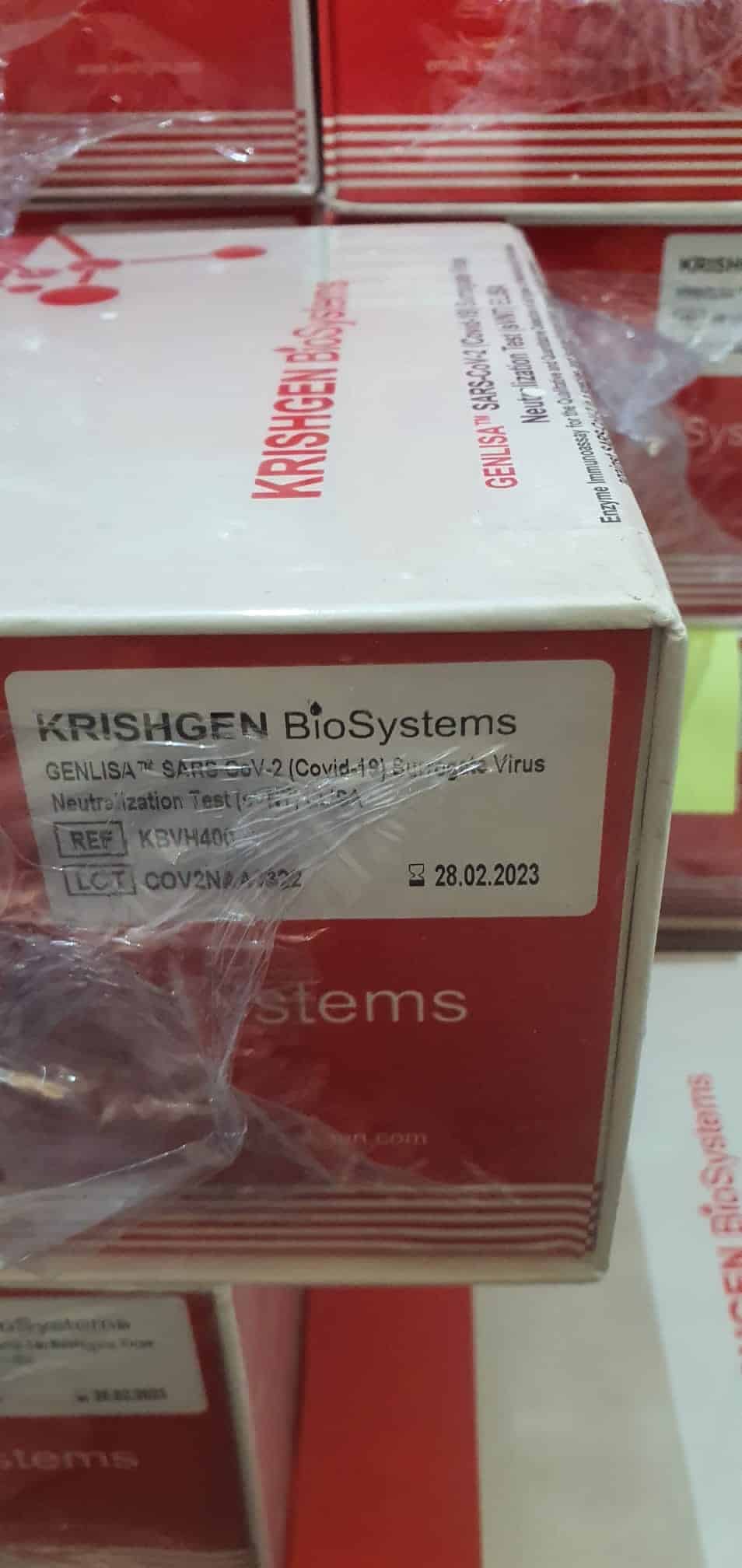
Description
The sVNT kit detects and measures circulating neutralizing antibodies against the SARS-CoV-2 virus. Neutralizing antibodies generated by the immune system after COVID-19 vaccination or infection function block the interaction between the receptor-binding domain (RBD) of the SARS-CoV-2 spike glycoprotein and the cell surface receptor human ACE2. Due to the crucial role of neutralizing antibodies, many vaccine companies and drug developers focus on testing for these antibodies. For example, vaccine developers frequently report the neutralizing antibody response induced by their vaccines.
In addition, drug development companies are currently developing neutralizing antibody-based drugs for the treatment of COVID-19 patients. The sVNT kit detects and measures neutralizing antibodies generated in response to vaccination against COVID-19. The kit also helps determine the efficacy of potential drugs in blocking the RBD-ACE2 interaction, regardless of whether these drugs are antibodies or small molecules. The kit further supports investigations of COVID-19 seroprevalence, assessment of herd immunity, and longevity of the protective immunogenic response. The sVNT test is species-independent and can be used to study SARS-CoV-2 infection in animals such as rats, mice, ferrets, and rabbits. The kit is a faster, easier, and higher throughput alternative to a live virus assay to detect neutralizing antibodies.
The sVNT test can be used for both qualitative and semi-quantitative detection of neutralizing antibodies against SARS-CoV-2. In qualitative mode, the test signals the presence or absence of neutralizing antibodies in a sample. In semi-quantitative mode, the test measures the relative amount of neutralizing antibodies against a calibrator using a standard curve (Figure 1a). Results are then displayed as high/medium/low neutralization (Figure 1b), or as units/mL or titre based on user preference.
(a) Calculation of the final neutralization titer. A standard curve was used to plot the neutralization response in the given samples. The final neutralization titer is calculated for each sample to help quantify the neutralization activity. The final neutralization titer is the product of the interpolated titer from the standard curve and the sample dilution factor required to achieve the OD450 value that falls within the linear range. The results identify samples with high (red), medium (blue), and low (green) neutralization titers.
(b). Data interpretation. The relative amount of virus-neutralizing activity in the samples was classified as “low”, “medium”, or high.”
Resume
- 96-well ELISA format test with ACE2 protein attached to the plate and HRP-labeled RBD used for detection.
- The test can be used with serum and plasma samples.
- Positive and negative controls are included in the kit.
- Calibrated against the WHO neutralization standard.
Note: Global patent protection for the kit will be firmly implemented.